


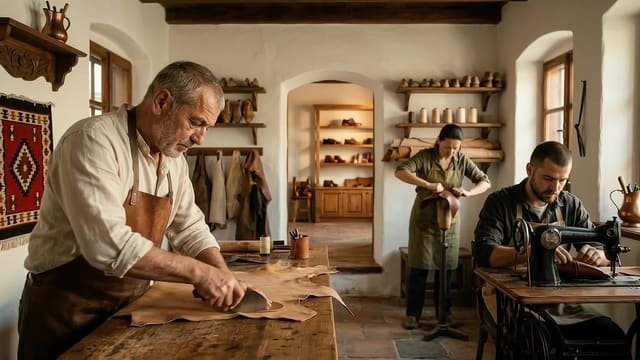
Illustrative film
Come in. We make shoes.
Gabrovo, Bulgaria. Natural leather, our own uppers and soles, since 2008.
The window
Real pairs. In the light.
These are photographs of the shoes themselves. Touch a pair to look closer.
Which way?
Men's to the left, women's to the right. The shelves are sorted by type.

Special lines
By enquiry
Military boots, moccasins and tsarvuli. They are not on the shelves: write to us about them.
Military boots Moccasins and traditional shoesWhere they come from
Gabrovo. By the Yantra.
In the middle of Bulgaria, at the foot of the Balkan range, Gabrovo has made practical, sturdy things for generations. Shoemaking is part of that history. We have worked here since 2008: we keep the craft we inherited and develop it with modern machines.
Our story- The Balkan range
- The Yantra
- since 2008

Along the bench
From hide to pair
Six stops. All under one roof.
Skip the walk-
Stop 1 of 6

Illustrative image Choosing the leather
Every hide is read by eye and by hand. A mark that gives it character stays. A defect does not.
-
Stop 2 of 6
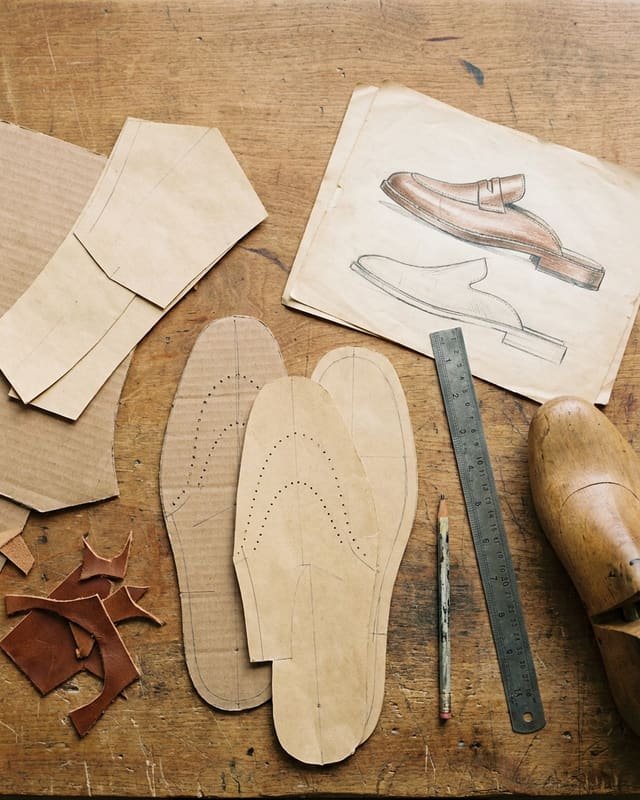
Illustrative image The pattern maker draws
A shoe starts on paper. Our pattern maker decides the shape, the lines and how it will sit on the foot.
-
Stop 3 of 6

Illustrative image Cutting
A robotic machine cuts the pieces precisely, the same way every time.
-
Stop 4 of 6

Illustrative image Stitching the upper
The pieces are stitched into the upper, the top part of the shoe. Machines sew, people watch the seam.
-
Stop 5 of 6
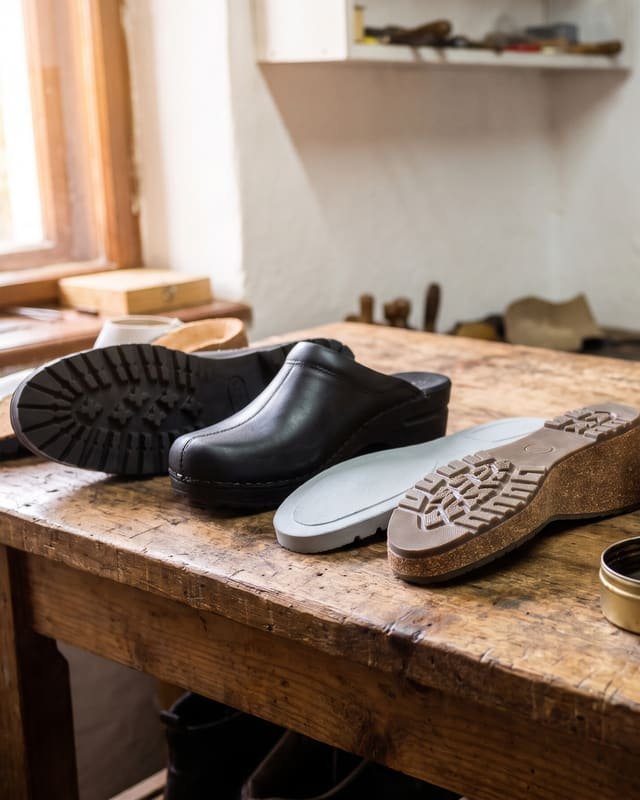
Illustrative image Making the sole
The soles are ours too. We do not buy them in ready-made.
-
Stop 6 of 6

Illustrative image Lasting and assembly
The upper is pulled over the last and joined to the sole. Only now is it a shoe.
-

And this pair is real.
Model 30, a leather clog. A photograph of the shoe itself.
The machine measures. The person judges.

What the machines do
They cut and they stitch. They repeat the same operation the same way, as many times as it takes.

What people decide
Which part of the hide goes where. Which mark is character and which is a defect. Where a model calls for hand stitching or hand lasting.
Not every model is made the same way, and not every model is made entirely by hand.
How we make the shoes
No two hides are alike
Natural leather has its own grain, its own pores, sometimes a small mark. That is why two pairs of the same model can differ slightly. With wear, the leather gradually settles to your foot.
Move a finger or the cursor and the light moves with you.
About materials and comfortFind your pair
Choose a model and a colour here. You buy on Amazon.de.
Or go straight to our Amazon.de store. Our Amazon.de store (Opens Amazon.de in a new tab)
Military boots, moccasins, tsarvuli or a trade question? Send an enquiry